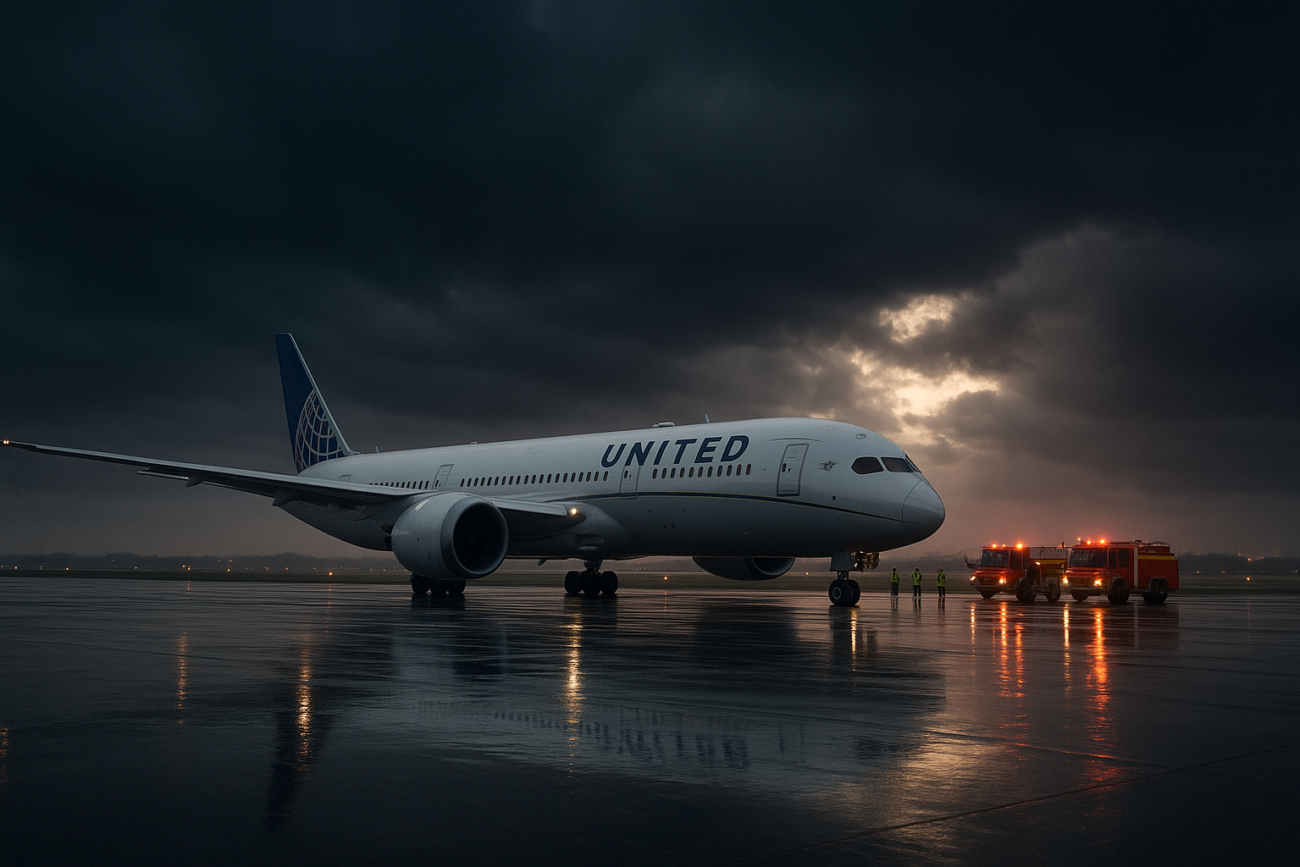
Every flight carries a quiet promise — you board, you fly, you land. Most of the time, that promise holds. But on May 27, 2025, passengers aboard United Airlines Flight UA770 got a stark reminder that aviation safety isn’t just a slogan. It’s a living, breathing system that activates the moment something goes wrong. The United Airlines Flight UA770 emergency diversion became one of the most discussed aviation incidents of 2025, sparking questions about aircraft technology, crew training, and what really happens when a plane declares an emergency mid-flight.
Flight UA770 Quick Facts
| Detail | Information |
|---|---|
| Flight Number | UA770 |
| Route | Barcelona (BCN) → Chicago O’Hare (ORD) |
| Aircraft | Boeing 787-9 Dreamliner |
| Tail Number | N26902 |
| Date of Incident | May 27, 2025 |
| Passengers Aboard | 257 |
| Crew Members | 12 |
| Diversion Airport | London Heathrow (LHR) |
| Emergency Code | Squawk 7700 |
| Injuries Reported | None |
What Triggered the United Airlines Flight UA770 Emergency Diversion
The flight departed Barcelona completely on schedule. Passengers settled into their seats, flight attendants began service, and the Boeing 787-9 Dreamliner climbed smoothly toward its cruising altitude of 37,000 feet over the Atlantic. By every measure, it was a routine transatlantic flight with nothing to suggest what was about to unfold inside the cockpit.
The Moment the Alert Changed Everything
Roughly 90 minutes into the flight, the cockpit received a critical alert. The flight crew detected irregular readings in the cabin pressurization system — the technology responsible for keeping air breathable at extreme altitude. The actual cabin pressure hadn’t dropped, and oxygen masks remained stowed, but the reading was abnormal enough to demand immediate action from the crew.
Pilots are trained to treat every warning as a real threat until proven otherwise. That mindset drove their next decision — declaring a general aviation emergency using Squawk 7700 and contacting Air Traffic Control to begin routing toward the nearest capable airport. The decision was made fast, calmly, and correctly.
What Squawk 7700 Actually Means
Squawk 7700 is a transponder code broadcast from the aircraft directly to radar systems on the ground. The moment a pilot activates it, every ATC screen in the region flags that aircraft as a declared emergency, triggering immediate priority treatment across the board. It’s not a distress signal in the dramatic sense — it’s a structured, professional communication that says “we have an abnormality, treat us as priority.”
How ATC Responds to a 7700 Declaration
When Squawk 7700 is activated, Air Traffic Control doesn’t wait. They clear surrounding airspace immediately, assign the aircraft a direct descent path to the nearest suitable airport, and notify the destination’s emergency response teams well before the plane arrives. For UA770, this meant London Heathrow received advance warning, runway 27R was prepared, and emergency vehicles were in position before the aircraft even began its final approach.
Why London Heathrow Was the Right Choice
Choosing where to divert a wide-body aircraft isn’t a random decision. The crew and operations team weigh proximity, airport capability, airline infrastructure, and medical support all at once. London Heathrow checked every box — it sits directly along the transatlantic corridor from Barcelona to Chicago, making it the closest major hub within safe range at the time of the alert.
The Infrastructure That Made Heathrow Ideal
Heathrow is one of Europe’s most prepared airports for emergency long-haul landings. It has the runway length, emergency medical teams, fire and rescue units, and technical facilities to handle a Boeing 787-9 efficiently. United Airlines also maintains maintenance and ground support operations at Heathrow, which meant the grounded aircraft could be properly inspected and affected passengers could be rebooked through an established airline hub rather than a smaller regional airport with limited resources.
The Full Incident Timeline
| Time (BST) | Event |
|---|---|
| ~90 min into flight | Pressurization alert detected in cockpit |
| Shortly after alert | Crew declares emergency, activates Squawk 7700 |
| Post-declaration | ATC clears airspace, routes UA770 to Heathrow |
| Pre-landing | Emergency vehicles positioned on Runway 27R |
| 4:55 PM BST | UA770 touches down safely at London Heathrow |
| Post-landing | Aircraft grounded for full technical inspection |
Understanding Cabin Pressurization and Why It Matters
At 37,000 feet, the outside atmosphere contains far too little oxygen to sustain human life. The cabin pressurization system solves this by continuously pumping compressed air into the fuselage, maintaining an internal environment equivalent to roughly 6,000 to 8,000 feet altitude — comfortable enough for passengers and crew to breathe normally throughout a long-haul flight without any supplemental oxygen.
Why Even a Sensor Alert Demands Immediate Action
When the pressurization system sends irregular readings, pilots can’t afford to wait and see. If genuine decompression goes unaddressed, passengers can experience hypoxia — dangerous oxygen deprivation that impairs judgment and consciousness, often without the person realizing it’s happening. The Boeing 787-9 Dreamliner is equipped with layered redundant monitoring specifically to catch these faults before they escalate, and on UA770, that system did exactly what it was designed to do — detect the problem early and give the crew time to act.
What Passengers Experienced on Board UA770
Passenger accounts from the UA770 diversion describe a cabin that stayed calm throughout the incident. The captain made a measured, professional announcement describing a technical irregularity requiring a precautionary landing. Flight attendants moved through the aisles with quiet efficiency, keeping people informed and settled without amplifying any anxiety on board.
How the Crew Kept Control of the Situation
No oxygen masks deployed during the UA770 emergency diversion, which confirmed the cabin remained pressurized the entire time. Aviation experts point to Crew Resource Management (CRM) training as the key reason diversions like this don’t turn into passenger panic situations. CRM teaches flight crews how to communicate clearly, delegate tasks under pressure, and project confidence even when managing a genuine abnormality at 37,000 feet. The UA770 crew executed it textbook-perfectly.
United Airlines’ Response After Landing
Once the aircraft touched down safely at Heathrow, United Airlines moved quickly to support the 257 affected passengers. Gate agents were already in position, and the airline’s ground teams began managing rebooking, accommodations, and communication almost immediately after the plane cleared the runway. The response drew generally positive reactions from passengers, many of whom took to social media to praise the crew and ground staff despite the obvious frustration of a disrupted journey.
What United Provided to Affected Passengers
United offered rebooking on the next available flights to Chicago O’Hare and alternate U.S. destinations. Passengers facing overnight stays received hotel accommodations and meal vouchers, while dedicated support staff handled individual queries about connections and onward travel. The speed of the airline’s ground response is a reflection of pre-planned emergency logistics — United, like most major carriers, maintains diversion response protocols that activate automatically the moment an emergency landing is confirmed.
Post-Incident Investigation and Aircraft Grounding
United Airlines grounded tail number N26902 immediately after landing at Heathrow. Both United’s engineering teams and Boeing technical staff initiated a joint post-incident review to inspect the pressurization system, examine structural components, and analyze data from the aircraft’s flight recorders. The goal was to identify the exact cause of the sensor irregularity and confirm the aircraft was airworthy before returning it to service.
What Aviation Authorities Required From United
The FAA doesn’t automatically launch a full investigation into every diversion, but it does require airlines to submit a detailed post-flight report whenever a Squawk 7700 is declared. That report covers the nature of the alert, the crew’s decision-making process, the aircraft’s technical status before and after landing, and the steps taken post-incident. This documentation feeds into broader aviation safety data, helping regulators and manufacturers identify patterns that might point to systemic issues across entire aircraft fleets.
What the UA770 Diversion Reveals About Modern Aviation Safety
The United Airlines Flight UA770 emergency diversion wasn’t a near-disaster. It was the opposite — it was every safety layer in modern commercial aviation doing exactly what it was built to do, in exactly the right sequence. The monitoring system caught the fault. The crew acted immediately. ATC cleared the path. Heathrow was ready. United’s ground team responded. The result: 269 people walked off the plane without a scratch.
Why Diversions Are Proof of Strength, Not Failure
| Safety Layer | Role in UA770 |
|---|---|
| 787-9 monitoring systems | Detected pressurization fault early |
| Pilot training and CRM | Fast, calm decision-making |
| Squawk 7700 protocol | Immediate ATC priority routing |
| Heathrow preparedness | Emergency units ready pre-landing |
| United ground response | Passenger rebooking and support |
Final Thoughts
The UA770 emergency diversion is ultimately a story about systems that work. A pressurization alert at 37,000 feet over the Atlantic triggered a chain of precise, professional decisions that ended with every single passenger and crew member landing safely at one of the world’s busiest airports. No injuries, no panic, no catastrophe — just aviation safety doing its job under pressure.
Commercial aviation doesn’t promise a perfect flight every time. What it does promise is a system so deeply layered with redundancy, training, and protocol that even genuine abnormalities rarely become tragedies. The United Airlines Flight UA770 emergency diversion proved that promise on May 27, 2025 — and it’s a reminder that the next time a captain comes on the intercom with unexpected news at 37,000 feet, the right response is to trust the crew. They’ve trained for exactly this.
