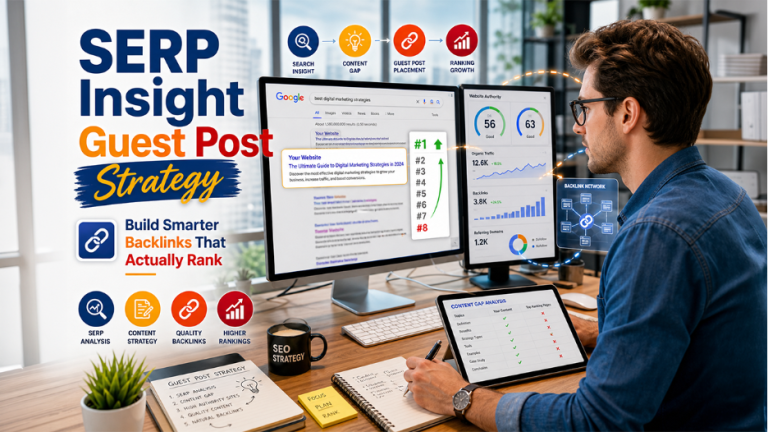
SERP insight link insertion has become one of the most discussed link building tactics heading into 2026, largely because it skips the slow, uncertain part of traditional outreach: guessing which pages deserve a backlink. Instead of starting with domain metrics and hoping for the best, this method starts directly from the search results page itself. Anyone researching SERP insight link insertion today needs to understand what separates it from a standard niche edit, what it actually costs, how the process works step by step, and where the real risks sit once money changes hands.
What SERP Insight Link Insertion Actually Means
SERP insight link insertion is the practice of placing a backlink inside an existing, already-ranking article on someone else’s website, where the target page itself is selected using search engine results data rather than guesswork. The mechanics are nearly identical to a traditional niche edit: a vendor or buyer finds a relevant site, negotiates with the owner, and the owner edits a live article to insert a new contextual link. The difference is in the selection process. A traditional niche edit picks a target page based on the site’s overall authority and general topical relevance. SERP insight link insertion instead starts by searching the exact target keyword on Google, identifying which pages are already ranking for it, and then pursuing placements specifically on those ranking pages.
This distinction matters because a page that already ranks on page one has already proven two things: Google trusts it enough to crawl it frequently, and it satisfies search intent for that keyword. Adding a contextual backlink inside that proven page transfers topical relevance and authority in a way that’s faster and more predictable than buying a link on a high-authority page that has no organic traffic or ranking history.
How the Process Works Step by Step
The workflow behind SERP insight link insertion follows a consistent sequence regardless of which vendor or platform handles it. It begins with keyword selection, meaning the buyer identifies a target keyword tied to a page they want to rank higher. From there, the vendor runs that keyword through Google and pulls the current top-ranking pages, typically focusing on results sitting between positions six and thirty, since pages already in the top five rarely need an authority boost and pages far down the rankings often lack the traffic or trust to pass meaningful value.
Once candidate pages are identified, the next step is filtering for topical alignment. A page can rank well and still be a poor fit if the surrounding content has nothing to do with the buyer’s target page. Quality vendors check whether the article’s subject matter genuinely supports a natural mention of the buyer’s link, rather than forcing an unrelated sentence into the text. After a page passes that filter, outreach begins: the vendor contacts the site owner, negotiates placement terms, and proposes where in the article the new link should sit, along with the anchor text. Reputable operators insert links inside body paragraphs where the content flows naturally, not in author bios, sidebars, or footers, since contextual in-content links carry significantly more weight with Google’s algorithms than peripheral placements.
Turnaround time for a single placement through an established marketplace is typically around three business days, assuming the publisher agrees quickly. Slower turnarounds usually mean the site owner is negotiating price or pushing back on the specific anchor text requested.
SERP Insight Link Insertion vs. Traditional Niche Edits
The terms “SERP insight link insertion” and “niche edit” are frequently used interchangeably, and for good reason: the underlying SEO mechanism and risk profile are identical in both cases. Whether a platform brands the service as one or the other, you’re still paying to have your link inserted into someone else’s existing, indexed content. The only meaningful difference is the research method used to choose the target page. A standard niche edit vendor browses competitor backlink profiles or relevant niche sites and picks pages based on domain rating and general subject match. A SERP insight approach instead reverse-engineers the actual search results, picking pages Google is already ranking and crawling for that specific term.
In practical terms, this means SERP insight link insertion tends to produce more keyword-specific relevance, since the target page is, by definition, already competing for the same search term the buyer cares about. It also tends to require slightly more research time upfront, since identifying genuinely ranking pages (rather than just high-authority ones) requires actually checking the live SERP rather than pulling numbers from a backlink tool.
SERP Insight Link Insertion vs. Guest Posting
Guest posting and link insertion solve different problems, and conflating them leads to wasted budget. A guest post means writing and publishing an entirely new article on someone else’s site, with your link included in that new content. This builds a fresh piece of content from zero, meaning it has to go through indexing and ranking before its link carries much weight, and the process depends heavily on content quality since the article itself is new and unproven.
Link insertion skips that entire ramp-up period. The host page is already live, already indexed, and already getting crawled by Google on a regular schedule, so a new link inserted into it gets discovered quickly rather than waiting months for a brand-new post to gain traction. The trade-off is editorial control: guest posts let the buyer shape the entire surrounding narrative and build new topical authority from scratch, while link insertion buyers are limited to whatever paragraph an existing article allows them to slot into. For competitive keywords or pages that already need a quick authority boost, link insertion is generally the faster lever. For content gaps where no existing page covers the topic well, guest posting remains the better fit.
Pricing in 2026
Pricing for SERP insight link insertion varies enormously depending on the source and the quality bar applied. Genuine manual placements, where a real person negotiates directly with an actual site owner on a relevant, organically trafficked page, typically run between $200 and $500 per link in 2026, with the exact number driven by the target site’s domain rating, traffic levels, and editorial standards. Vendors operating at this tier usually offer a limited number of revision rounds if the site owner objects to the proposed placement or anchor text.
Bulk placements sit at a much lower price point, generally $50 to $150 per link. At that range, the inventory typically comes from a marketplace of lower-traffic blogs that accept paid links as a matter of course, and a portion of that inventory may consist of private blog networks or repurposed expired domains rather than genuinely active, organically read websites. Marketplace platforms that aggregate large numbers of registered publisher sites, sometimes numbering well over a thousand, allow buyers to filter by metrics and request specific service types, but the underlying quality still has to be vetted manually since metrics alone don’t confirm real traffic or editorial oversight.
Risks and Vetting Considerations
The single biggest risk in SERP insight link insertion is paying for a link on a page that looks strong on paper but delivers no real value. A domain rating of 60 means nothing if the specific page receiving the link has no organic traffic and no genuine topical connection to the buyer’s target keyword. Before committing budget, buyers should independently verify organic traffic to the specific page (not just the domain), confirm the site’s overall backlink profile isn’t flagged for spam or toxic patterns, and check that the content genuinely reads as edited by a real person rather than auto-generated filler designed purely to host paid links.
Permanence is another factor that’s frequently glossed over in vendor marketing. Many link insertion services, including some of the larger SERP-data-driven marketplaces, only guarantee that a placed link stays live for a set period, often up to 365 days, rather than permanently. Buyers expecting a lifetime backlink should confirm this term explicitly before paying, since a link that disappears after a year requires either renewal spending or a fresh placement to maintain the same authority signal.
Where Link Insertion Fits in a Broader Strategy
SERP insight link insertion works best as one component of a larger SEO program rather than a standalone tactic. It’s most effective on pages that are already reasonably well optimized, sit somewhere in the middle of the rankings, and belong to a site with enough existing domain strength that an additional authority signal will actually move the needle. Pages with thin content, weak on-site SEO, or a domain with little established trust tend to see limited benefit from link insertions alone, since the tactic amplifies existing strength rather than fixing foundational gaps.
A diversified backlink profile, mixing link insertions with original guest content, organic digital PR mentions, and internal linking improvements, continues to outperform any single tactic used in isolation, particularly as Google and AI-driven search systems increasingly weigh contextual relevance and genuine user intent over raw link volume.
Frequently Asked Questions
What is SERP insight link insertion in simple terms?
It’s the practice of adding a backlink into an existing, already-ranking article, where the target page is chosen by analyzing live Google search results for a specific keyword rather than picking a site based on general authority alone.
Is SERP insight link insertion the same as a niche edit?
Yes, the underlying SEO process and risk profile are identical. The only difference is that SERP insight link insertion specifically selects target pages based on what’s currently ranking for the buyer’s exact keyword.
How much does a SERP insight link insertion cost in 2026?
Genuine manual placements on real, organically trafficked sites typically cost $200 to $500 per link, while bulk marketplace placements range from roughly $50 to $150 per link, often with lower editorial quality.
How long does a link insertion placement take?
Through an established marketplace, turnaround is typically around three business days per placement, though it can extend if the publisher negotiates on price or anchor text.
Are link insertion placements permanent?
Not always. Many providers only guarantee the link stays live for up to a year, so buyers should confirm permanence terms before paying.
