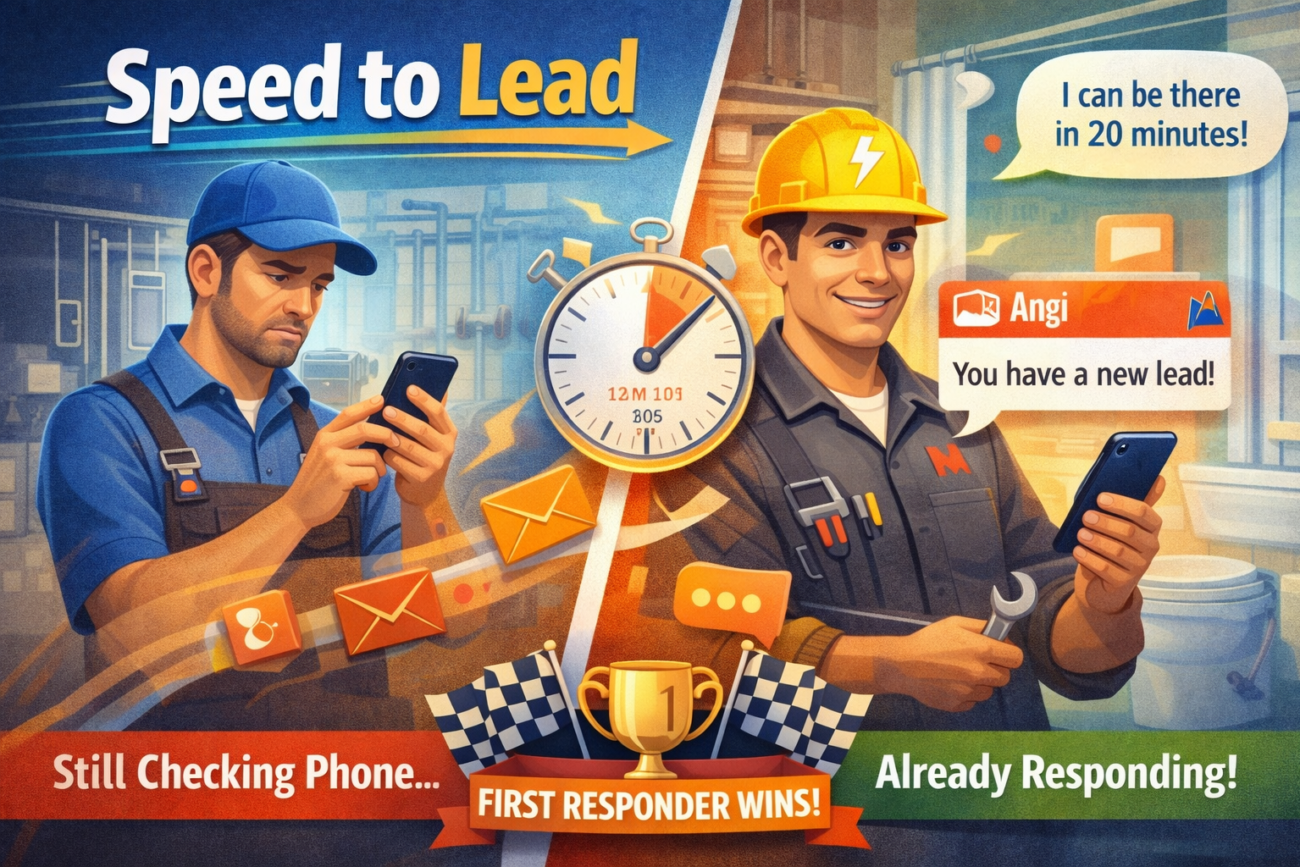
Every contractor knows the feeling. You are on a roof, under a sink, or driving between jobs. Your phone buzzes with a new lead from Yelp or Thumbtack. By the time you pull over, dry your hands, and open the app, 45 minutes have passed. The homeowner already booked someone else.
This is the speed to lead problem, and for home service businesses, it is quietly destroying their return on advertising spend.
What Speed to Lead Actually Means for Contractors
Speed to lead is the time between a potential customer reaching out and your business responding. In a B2B sales context, people debate whether five minutes or 15 minutes is fast enough. In home services, the window is far more aggressive.
When a homeowner has a burst pipe, a dead AC unit in August, or a garage door that will not open, they are not casually browsing. They are contacting two, three, sometimes five businesses at once through Yelp, Thumbtack, Angi, and Google. The first business to respond with something useful wins the job roughly 78% of the time, according to research from MIT and InsideSales.
That number bears repeating. Nearly four out of five homeowners go with whoever responds first. Not the cheapest. Not the one with the best reviews. The first one to actually engage.
The Data Is Not New but the Problem Is Getting Worse
The original speed to lead research dates back to a 2007 MIT study by Dr. James Oldroyd that analyzed over 15,000 leads. The findings were stark. Contacting a lead within five minutes made businesses 100 times more likely to connect compared to waiting 30 minutes. After five minutes, lead quality dropped 80%.
Harvard Business Review later cited this research, confirming that companies responding within one hour were seven times more likely to qualify a lead than those who waited two hours.
These numbers were dramatic when the research was published. Today the situation is worse for slow responders, not better. Consumer expectations have shifted. Platforms like Yelp now factor response time into their business ranking algorithms. Google Local Services Ads track responsiveness and reward fast responders with better ad placement and lower cost per lead.
The competitive dynamics have intensified too. A decade ago, a homeowner might call one or two contractors from the Yellow Pages. Now they submit a request on Thumbtack and get matched with five pros simultaneously. They message three plumbers on Yelp while Googling two more. The contractor who responds first is not just making a good impression. They are often the only one who gets a conversation at all.
Why Contractors Are Structurally Disadvantaged
The speed to lead challenge is harder for home service businesses than for almost any other industry. A software sales rep sits at a desk with notifications in front of them all day. A plumber’s hands are literally inside a wall.
Consider the typical day for a solo HVAC tech or a two-person plumbing crew.
They leave for the first job at 7:30 AM. From that point until lunch, they are physically working. Crawlspace, attic, under a house. Hands are dirty, gloves are on, the phone is in the truck. A lead comes in at 9:15 AM through Yelp. The tech does not see it until 11:45 AM when they get back to the truck. Two and a half hours. That lead is gone.
After lunch, they drive to the next job. Another lead comes in at 2 PM through Thumbtack. They are knee-deep in a water heater replacement. They see the notification at 3:30 PM. An hour and a half. Gone.
By 5 PM, they have missed three or four leads that each cost them $30 to $80 in advertising spend. That is $120 to $320 wasted in a single day. Over a month, it adds up to $2,400 to $6,400 in leads that went to competitors because nobody was available to type a reply.
This is not a motivation problem. These are hardworking people who care about every customer. It is a structural problem. The nature of the work makes real-time lead response almost impossible without some kind of system.
The Approaches That Work and the Ones That Do Not
Contractors have tried several approaches to solve the speed to lead gap, with varying results.
Hiring a receptionist or office manager. This works during business hours but most home service leads come in during evenings and weekends when homeowners are actually at home noticing problems. A full-time receptionist costs $35,000 to $50,000 per year and still leaves 40 to 60 percent of the lead window uncovered.
Virtual answering services. These handle phone calls reasonably well but most cannot manage Yelp messages, Thumbtack conversations, Angi form submissions, or website chat leads. Each platform has its own messaging system and a call center agent reading from a script does not have the context to qualify a roofing lead differently from a plumbing lead. The response is fast but generic, and homeowners can tell.
Setting up better phone notifications. Some contractors configure aggressive notification settings so every lead pings their phone immediately. This helps awareness but not response capability. Knowing a lead came in while you are soldering a copper joint does not mean you can respond to it.
AI-powered lead response systems. This is the category that has gained the most traction over the past year. Tools built specifically for home service businesses now connect to Yelp, Thumbtack, Angi, Google LSA, and website forms simultaneously. When a lead comes in on any channel, the AI sends a personalized response within seconds that is tailored to the specific platform and the business’s services.
The difference from a generic chatbot is important. A chatbot sends a canned reply. A speed to lead tool like LeadTruffle understands what the business does, what service area they cover, what questions to ask to qualify the job, and when to hand the conversation off to a human. It works at 9 PM on a Saturday the same way it works at 10 AM on a Tuesday.
The qualification step is what makes this more than a fancy auto-reply. The AI asks the homeowner what they need done, where they are located, and what their timeline looks like. It collects the information the contractor needs to decide if the job is worth pursuing. When the contractor checks their phone at the end of the day, they do not see a list of unread messages. They see a list of qualified leads with job details, addresses, and conversation transcripts ready for follow-up.
Platform-Specific Response Challenges
Each lead platform has its own mechanics that affect the speed to lead equation.
Yelp sends Request a Quote messages that require a response through their messaging system. Yelp tracks business response behavior through a Response Quality Score that affects visibility to future customers. Slow or inconsistent responses can actually reduce the number of leads Yelp sends you, creating a downward spiral. A Yelp auto responder that handles first responses within the platform is important because the response has to happen inside the Yelp channel, not through a separate text or email.
Thumbtack matches homeowners with multiple pros for the same job simultaneously. This is the most directly competitive lead environment in home services. The pro who responds first dominates the conversation. Thumbtack’s own data and community forums are full of pros discussing how response speed is the primary factor in winning jobs. A Thumbtack autoresponder that handles the initial reply within seconds makes the difference between being first and being ignored.
Google Local Services Ads are phone-call-first. Missed calls during busy hours are the single biggest waste of LSA ad spend. Google’s responsiveness score directly impacts ad ranking and cost per lead. Businesses that answer or return calls quickly earn better placement.
Angi sends form-based leads to multiple businesses at once. The same homeowner request goes to three or four contractors. First meaningful response wins, but Angi leads often need more qualification since the initial form data is limited.
For businesses advertising on more than one platform, which most do, the compound effect is significant. You need to respond fast on all of them simultaneously, across every hour of the day.
Calculating What Slow Response Actually Costs
Most contractors know their monthly ad spend but very few have calculated the dollar cost of slow response time. Here is a simple way to estimate it.
Take your monthly spend across all lead platforms. Divide by the total number of leads received. That is your cost per lead. For most home service categories, this is somewhere between $25 and $100 per lead.
Now look at how many of those leads you respond to within five minutes versus after 30 minutes or more. If the research holds and responding within five minutes makes you 100 times more likely to connect, then every lead you respond to after 30 minutes is nearly worthless in competitive markets where other businesses are responding faster.
A contractor spending $2,000 per month on leads who responds to half of them after 30 minutes is effectively burning $1,000 per month. That is $12,000 per year in advertising dollars converted into nothing because of response time alone.
The return on investment for any speed to lead improvement tool should be measured against this number, not against the tool’s subscription cost. A $200 per month AI response system that saves even a fraction of $12,000 in wasted leads pays for itself many times over.
What Contractors Should Do This Week
If you are a home service business owner reading this, here are three things you can do right now to understand your speed to lead situation.
First, audit your actual response times. Check Yelp’s response metrics in your business dashboard. Look at Thumbtack conversation timestamps. Review your call log against Google LSA notifications. The numbers are usually worse than you think.
Second, quantify your after-hours gap. Pull up your lead data and filter by time of day. How many leads come in between 6 PM and 8 AM? How many come in on weekends? If you are not monitoring those windows, that entire segment is going to competitors by default.
Third, calculate your cost per wasted lead. Monthly ad spend divided by total leads gives you cost per lead. Multiply that by the percentage of leads where your response time exceeded 30 minutes. That is the minimum amount slow response is costing your business every month.
The tools and systems to fix this exist now and they are more affordable than hiring. Whether you automate first responses with AI, hire a dedicated lead handler, or build a better notification workflow, the math is clear. In a market where the first responder wins the overwhelming majority of jobs, speed to lead is not a nice-to-have metric. It is the most direct lever you have to increase revenue without spending another dollar on advertising.
